About Us
Company Profile
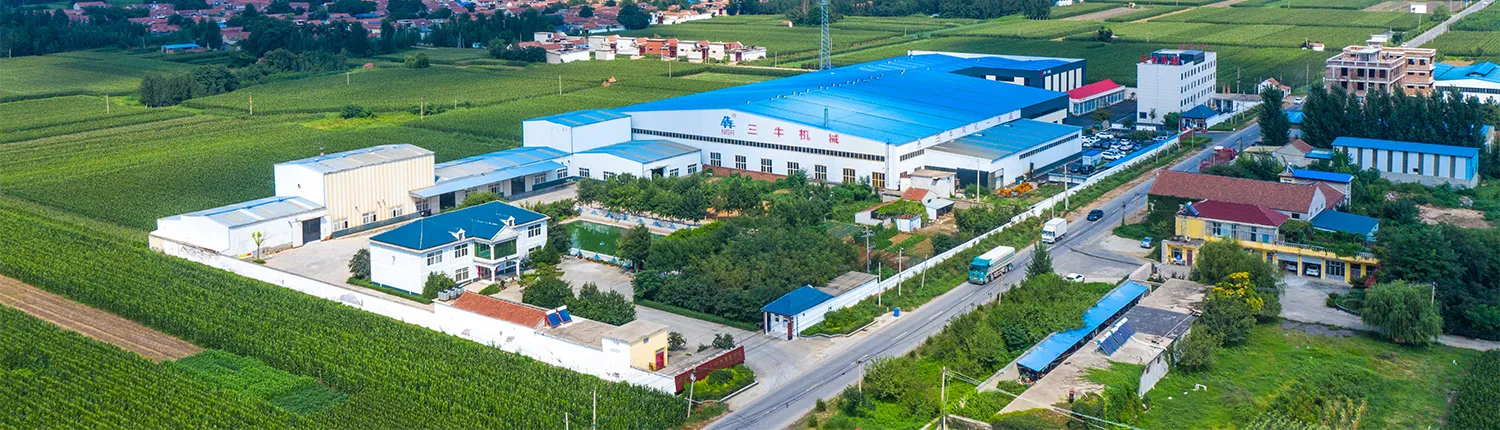
Shandong Sanniu Machinery Group Co., Ltd. is a professional manufacturer with more than ten years of experience in the design and production of Roots blowers. The company has invested more than 150 million yuan in the construction of the first three phases, and the fourth phase is expected to receive an investment of 0.1 billion yuan. It has developed into a comprehensive modern enterprise integrating R&D, design, manufacturing and operation.
Located in Xianggongzhuang Town, Zhangqiu District, known as a renowned machinery processing base, the company enjoys convenient transportation. It is 50 kilometers away from Jinan, the provincial capital, and Jinan High-speed Railway Station, 40 kilometers from Jinan International Airport, and 10 kilometers from the Diaozhen Exit of G20 Qingyin Expressway. Our main products include Sanniu blowers, Roots blowers and Roots vacuum pumps.
The company’s self-owned "Ben" brand blowers cover eight series with thousands of specifications. Our products are independently developed on the basis of widely absorbing advanced technologies from home and abroad. We own more than ten blower-related patents and have achieved remarkable results in energy conservation and noise reduction. In recent years, the company has made heavy investments to introduce imported high-precision equipment including horizontal machining centers, vertical machining centers, coordinate measuring machines, two-way CNC surface planers and CNC boring and milling machines. We implement strict control over production processes and spare parts procurement channels to fully guarantee qualified product quality.
Our products are widely applied in sewage treatment, pneumatic conveying, vacuum packaging, aquaculture, grain processing, electric power, petrochemical industry, cement production, mining, special gas transportation and pressurization and other fields. Our products sell well across China and are exported to North America, Malaysia, Indonesia, the Philippines, Vietnam, South Africa, Japan and other countries. We have set up sales outlets and after-sales service centers nationwide and in neighboring regions to provide customers with high-quality and efficient services. Having passed ISO9001 international quality system certification, the company has established a complete quality assurance system covering design, manufacturing, installation and after-sales service. We realize full-process independent control from R&D design to finished product delivery, which provides solid and reliable support for stable performance and long service life of our products.
Main Products of Sanniu Blower
Roots Blower, Roots Vacuum Pump, Intensive Roots Blower, High Pressure Roots Blower, Biogas Booster Blower, Multi-set Centrifugal Blower, Desulfurization Blower, Aeration Blower
Aeration Blower
Blast aeration refers to the process of pressing air or other gases into water or liquid through conveying and diffusing devices by blowers with designated air volume and pressure, and the blower used for this process is defined as an aeration blower.
Characteristics of Aeration Blower
- Sufficient air volume: Aeration is designed to increase dissolved oxygen in water or liquid to meet the oxygen consumption demand of aerobic organisms.
- Adequate pressure: Aeration is a gas-liquid mass transfer process. Sufficient pressure enables gas to fully diffuse and make contact with liquid, and prevents suspended substances from settling.
Main Application Fields
- Blast aeration for aquaculture
- Blast aeration for sewage treatment
Roots Vacuum Pump
Roots vacuum pumps are widely used industrial equipment. To ensure stable operation, users need to be familiar with their structural layout and transmission modes.
1. Overall Structure of the Pump
The structural layout of the pump casing determines the overall form of a Roots vacuum pump. Three mainstream structures are adopted globally:
- Vertical structure: The air inlet and outlet are horizontally arranged for easy pipeline connection. However, it features a high center of gravity and poor stability at high rotating speeds, so it is mostly applied to small-sized pumps.
- Horizontal structure: The air inlet is on the top and the exhaust outlet is at the bottom. The exhaust port can also be horizontally arranged to make the air intake direction perpendicular to the exhaust direction, and the outlet can be reserved on either the left or right side. This structure has a low center of gravity and stable high-speed operation, which is commonly used for medium and large pumps.
- Vertically installed rotor shaft structure: The two rotor shafts are perpendicular to the horizontal plane. This design facilitates clearance control and rotor assembly with a small floor area, while its disadvantages lie in high center of gravity, inconvenient gear disassembly and relatively complex lubrication systems.
2. Pump Transmission Modes
The two rotors of the Roots vacuum pump run synchronously driven by a pair of high-precision gears, and the driving shaft is connected to the motor via a coupling. There are two main transmission layouts:
- The motor and gears are mounted on the same side of the rotors. The driven rotor is driven directly by gears at the motor end, leading to tiny torsional deformation of the driving shaft and uniform rotor operating clearance. Its drawbacks include complicated shaft machining and assembly, inconvenient gear adjustment and unbalanced overall gravity distribution.
- The motor and transmission gears are installed on two opposite sides of the rotors. This symmetrical structure requires high-rigidity drive shafts to maintain stable rotor clearance, yet it features easy disassembly and assembly, thus being widely adopted in practical applications.
Roots Blower
Roots blower is one of the most widely used ventilation equipment. Traditional two-lobe Roots blowers have been replaced by low-noise and eco-friendly three-lobe products. Conventional air-cooled single-tank Roots blowers have also been upgraded to low-noise double-tank, water-cooled and oil-cooled models.
A Roots blower consists of a casing, side plates and two three-lobe impellers. Driven by a set of synchronous gears, the two impellers rotate reversely at the same speed. The tiny gaps between impellers separate the suction and exhaust chambers, and the rotating impellers convey gas inside the casing to realize air pressurization and delivery.
Equipped with frequency conversion control, the blower can realize precise air volume adjustment, which is more flexible than traditional valve control to satisfy various production requirements. Frequency conversion technology enables soft start of the motor to avoid the impact of high starting current. Without a frequency converter, the direct starting current can reach 200–300A, which may cause damage to the motor and power grid. With frequency soft start, the starting current is controlled below the rated 46A, effectively reducing instantaneous pressure impact on the blower and extending the service life of the whole equipment. When the operating speed is reduced to 60% of the original rated speed, pipeline vibration and running noise are greatly lowered, which prolongs the service life of blowers, motors and bearings and cuts down daily maintenance costs.