

Roots vacuum pump: the structural principle of Roots vacuum pump
2020-12-04
Summary
Roots vacuum pump is a commonly used equipment in enterprises. During normal use, we need to understand the structure and transmission mode of the equipment. Below, let us understand together! 1. The overall structure of the pump The arrangement of the pump body of the Roots vacuum pump determines the overall structure of the pump. At present, the overall structure of Roots vacuum pumps at home and abroad is roughly three:
Roots vacuum pumpIs the enterprise commonly used equipment. During normal use, we need to understand the structure and transmission mode of the equipment. Below, let us understand together!
1. The overall structure of the pump
The arrangement of the pump body of the Roots vacuum pump determines the overall structure of the pump. At present, the overall structure of Roots vacuum pumps at home and abroad is roughly three:
(1) The intake and exhaust ports of the vertical structure are placed horizontally to make the assembly and connection of the pipeline easier. However, this pump has a high center of gravity and poor stability during high-speed operation, so this type is mainly used for small pumps.
(2) The air inlet of the horizontal pump is at the top and the air outlet is at the bottom. Sometimes, in order to facilitate the installation and connection of the vacuum system pipeline, the exhaust port can be connected from the horizontal direction, that is, the intake direction and the exhaust direction are perpendicular to each other. At this time, the exhaust port can be opened from the left or right, except for one end of the exhaust pipe, the other end is blocked or connected to the bypass valve. The pump structure has a low center of gravity and good stability during high speed operation. Usually, large and medium-sized pumps use this structure.
(3) The two rotor shafts of the pump are installed perpendicular to the horizontal plane. The assembly gap of this structure is easy to control, the rotor is easy to assemble, and the pump occupies a small area. However, the center of gravity of the pump is high, the disassembly and assembly of the gears are inconvenient, and the lubrication mechanism is relatively complicated.
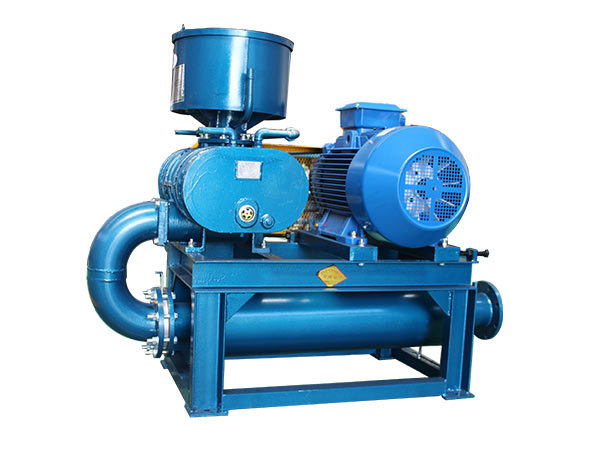
2. Drive mode of pump
The two rotors of the Roots vacuum pump operate relatively synchronously through a pair of high-precision gears. The driving shaft is connected with the motor through a coupling. There are two main types of the layout of the transmission structure: one is that the motor and the gear are located on the same side of the rotor, and the driven rotor is directly driven by the gear at the motor end, so the torsional deformation of the drive rotor shaft is small, and the gap between the two rotors will not change due to the large torsional deformation of the driving shaft, so the gap between the rotors is running the process is uniform. The disadvantages of this transmission mode are: a. there are three bearings on the driving shaft, which increases the difficulty of processing and assembly of the pump, and it is inconvenient to disassemble and adjust the gear; B. the overall structure is uneven, and the center of gravity of the pump is biased to one side of the motor and gear box.
The other is that the motor and transmission gear are installed on both sides of the rotor. This form makes the overall structure of the pump symmetrical, but the torsional deformation of the driving shaft is relatively large. In order to ensure that the rotor has a uniform gap during operation, the shaft should have sufficient rigidity, and the connection between the shaft and the rotor should be tight. This structure is easy to disassemble and assemble, so it is widely used.
Contact Us
E-mail:
sanniu888@126.com
Telephone:
400-6531-228/0086-531-83288777
Address:East Industrial Park, Xianggong Sub-district Office, Zhangqiu District, Jinan City, Shandong Province